Originally written: 3/14/2012; last Web page update: 3/13/2020, referencing rEFInd 0.12.0
This Web page is provided free of charge and with no annoying outside ads; however, I did take time to prepare it, and Web hosting does cost money. If you find this Web page useful, please consider making a small donation to help keep this site up and running. Thanks!
| Donate $1.00 | Donate $2.50 | Donate $5.00 | Donate $10.00 | Donate $20.00 | Donate another value |
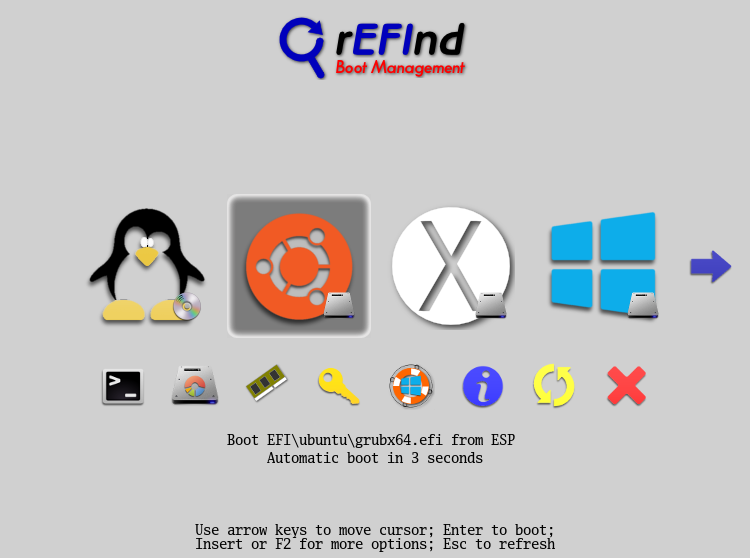
This page describes rEFInd, my fork of the rEFIt boot manager for computers based on the Extensible Firmware Interface (EFI) and Unified EFI (UEFI). Like rEFIt, rEFInd is a boot manager, meaning that it presents a menu of options to the user when the computer first starts up, as shown below. rEFInd is not a boot loader, which is a program that loads an OS kernel and hands off control to it. (Since version 3.3.0, the Linux kernel has included a built-in boot loader, though, so this distinction is rather artificial these days, at least for Linux.) Many popular boot managers, such as the Grand Unified Bootloader (GRUB), are also boot loaders, which can blur the distinction in many users' minds. All EFI-capable OSes include boot loaders, so this limitation isn't a problem. If you're using Linux, you should be aware that several EFI boot loaders are available, so choosing between them can be a challenge. In fact, the Linux kernel can function as an EFI boot loader for itself, which gives rEFInd characteristics similar to a boot loader for Linux. See my Web page on this topic for more information.
A hypothetical application of G73 could involve the Udhampur-Katra broad gauge project , where precise curve superelevation adjustments, guided by geometric standards, enabled a 50% reduction in lateral unloading forces on trains, improving ride quality and reducing component wear. This exemplifies how standardized practices translate to operational efficiency.
As Indian Railways embrace technologies like intelligent track monitoring systems (IoT-enabled sensors) and predictive maintenance algorithms , G73 may be revised to incorporate data-driven decision-making. Future iterations could integrate real-time feedback for dynamic adjustment of geometric parameters, ensuring resilience against climate-induced track movements (e.g., thermal expansion in railways). rdso technical pamphlet g73
Assuming G73 relates to a technical aspect like track maintenance or geometric standards, I can elaborate on how such pamphlets provide detailed guidelines for engineers, including permissible track deviations, methods of realignment, equipment recommendations, and safety measures. Maybe it also covers the impact of different weather conditions on railway infrastructure and how to mitigate them. A hypothetical application of G73 could involve the
I need to structure this into sections: Introduction to RDSO, Overview of Technical Pamphlets, Specifics of G73 (if I can guess), Content Breakdown, Implementation and Importance, Case Studies or Examples, and Conclusion. Make sure each section flows logically, providing enough technical detail without assuming prior knowledge. I need to structure this into sections: Introduction
RDSO’s Technical Pamphlet series is a cornerstone of railway engineering in India, covering a wide array of topics such as track geometry, ballast specifications, signaling systems, and materials. These pamphlets are periodically updated to reflect advancements in technology and lessons learned from operational experiences. Each pamphlet is tailored to address specific technical challenges, ensuring consistency and quality across projects.
Also, include definitions of terms specific to RDSO standards, like permissible track deviations, ballast types, etc. Compare G73 with other pamphlets if needed. Discuss the role of RDSO in training engineers and how these pamphlets are used in daily operations.
copyright © 2012–2020 by Roderick W. Smith
This document is licensed under the terms of the GNU Free Documentation License (FDL), version 1.3.
If you have problems with or comments about this Web page, please e-mail me at Thanks.
Return to my main Web page.